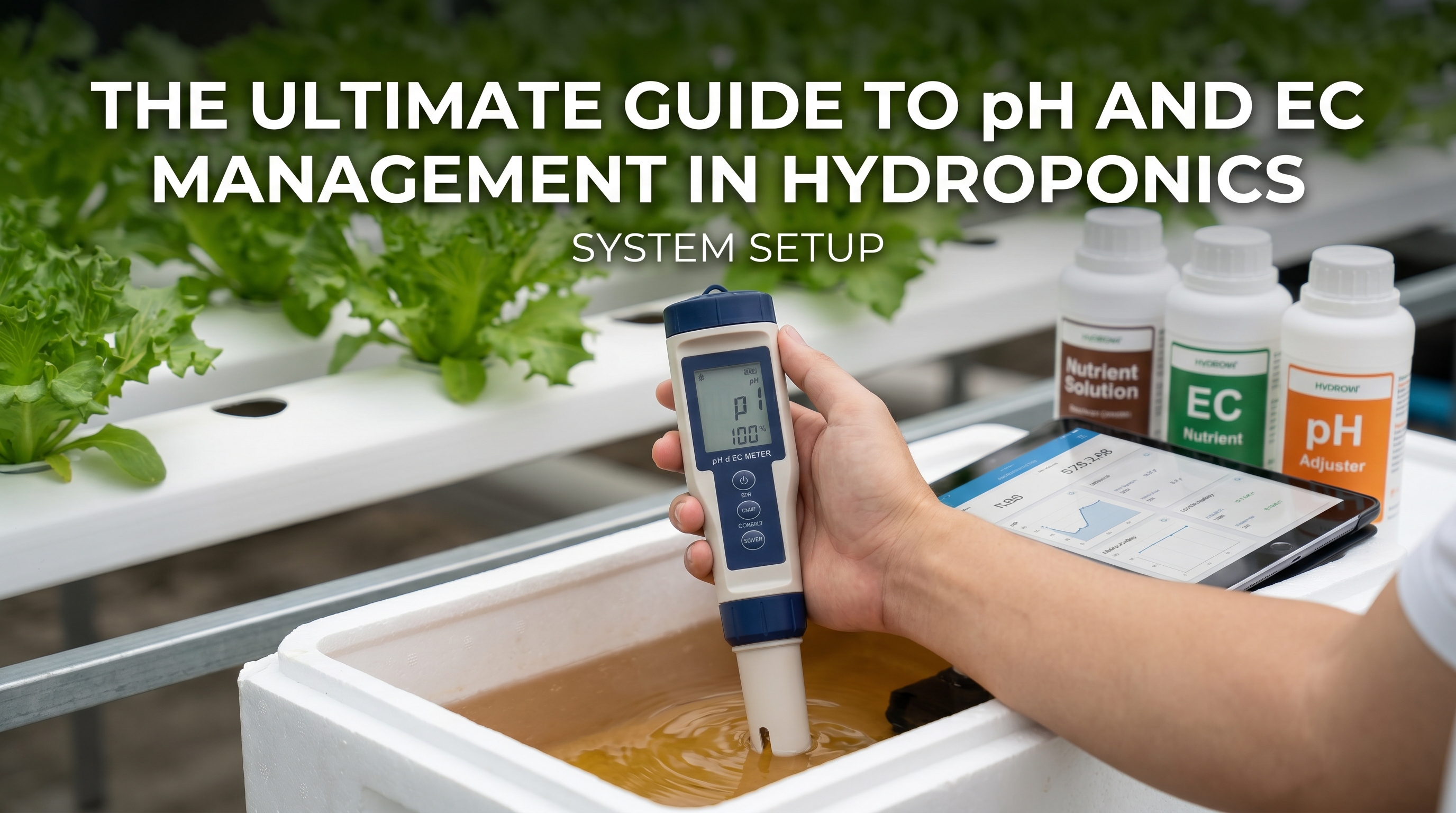
Welcome to the invisible engine of your hydroponic garden: water chemistry. You can have the most expensive grow lights, the perfect temperature, and the highest-quality seeds, but if your water chemistry is off, your plants will struggle to survive, let alone thrive.
In hydroponics, we don't have soil to act as a buffer. We are the soil. That means we are entirely responsible for delivering the exact balance of nutrients our plants need directly to their root zones. The two most critical metrics for doing this successfully are pH (Potential of Hydrogen) and EC (Electrical Conductivity).
Whether you are growing crisp lettuce in a simple Deep Water Culture (DWC) setup or managing a complex Nutrient Film Technique (NFT) system for fruiting tomatoes, mastering these two metrics is non-negotiable. Let's break down these concepts simply so you can measure, adjust, and stabilize your nutrient solutions like a pro.
Demystifying pH: The Gatekeeper of Nutrients
What is pH?
At its core, pH is a measurement of how acidic or alkaline a liquid is. The scale runs from 0 to 14, with 7.0 being perfectly neutral (like pure distilled water). Anything below 7.0 is acidic, and anything above 7.0 is alkaline.
Why pH Matters in Hydroponics
Think of pH as the gatekeeper to your plant's root system. Even if your reservoir is packed with the perfect blend of expensive nutrients, your plants cannot absorb them if the pH is incorrect. This phenomenon is known as "nutrient lockout."
Most hydroponic plants prefer a slightly acidic environment, typically ranging between 5.5 and 6.5.
* If the pH drops too low (below 5.0): Macronutrients like Calcium and Magnesium become locked out, leading to stunted growth and leaf curling.
* If the pH rises too high (above 6.5): Micronutrients like Iron and Manganese become unavailable. Iron deficiency is incredibly common in high-pH systems, presenting as yellowing leaves with dark green veins (interveinal chlorosis).
Understanding EC: The Food Gauge
What is EC (Electrical Conductivity)?
While pH tells you if the plants *can* eat, EC tells you *how much food* is on the table.
Pure water does not conduct electricity. However, when you dissolve mineral salts (your hydroponic nutrients) into the water, it becomes conductive. By measuring the Electrical Conductivity of your reservoir, you are measuring the total concentration of dissolved nutrients. Higher EC means a stronger nutrient solution; lower EC means a weaker one.
EC vs. PPM: What's the Difference?
You will often hear growers talk about PPM (Parts Per Million) alongside EC. Here is the secret: they are measuring the exact same thing. EC is the universal, scientific standard for measuring nutrient concentration. PPM meters actually measure EC first, and then apply a mathematical conversion factor to estimate the parts per million.
*Pro Tip:* Always use EC when discussing nutrient strength with other growers or following feeding charts. Because different meter brands use different conversion factors for PPM (the 500 scale vs. the 700 scale), PPM can be highly confusing. EC is universal.
How to Measure Your Water Chemistry
Essential Tools for the Job
To manage your system effectively, you need the right tools:
1. A reliable pH meter: Skip the cheap paper test strips or liquid drop kits. Invest in a quality digital pH pen.
2. An EC/TDS meter: These are generally robust and less prone to calibration drift than pH meters.
3. Calibration solutions: You need pH 4.0 and pH 7.0 buffer solutions to keep your pH meter accurate.
4. pH Up and pH Down: Commercial solutions (usually Potassium Hydroxide for Up, and Phosphoric Acid for Down) to adjust your water.
The Step-by-Step Measurement Routine
Consistency is key. Follow this routine every time you check your reservoir:
1. Stir the reservoir: Ensure the water is thoroughly mixed before taking a reading.
2. Measure EC first: Always check your nutrient concentration before checking pH. Adding nutrients will naturally alter the pH of your water.
3. Measure pH second: Once your EC is dialed in, take your pH reading.
Adjusting and Stabilizing Your Nutrient Solution
How to Adjust EC
Adjusting EC is straightforward:
* To raise EC: Add more nutrient solution. Always mix your nutrients in a separate container of water before adding them to the main reservoir to prevent chemical reactions that cause nutrient fallout.
* To lower EC: Add fresh, pH-balanced water to dilute the solution.
How to Adjust pH
Adjusting pH requires a delicate touch.
* Dilute first: Never pour concentrated pH Up or Down directly into your reservoir. Mix the required amount into a small cup of water first, then pour that mixture into the reservoir.
* Go slow: Add adjustments in small increments. Wait 10-15 minutes for the solution to circulate completely before taking another reading.
* Never mix Up and Down: If you overshoot your target pH, do not add the opposite adjuster immediately. Mixing these concentrated acids and bases can cause dangerous reactions and ruin your nutrient profile. Instead, dilute with fresh water or wait a day.
The Art of Stabilization
One of the most frustrating experiences for a beginner is "pH drift"—when you set your pH to 5.8 at night, only to find it at 6.5 the next morning. Some drift is natural as plants consume water and nutrients, but wild swings are problematic.
Here is how to stabilize your system:
* Increase reservoir size: The larger the volume of water, the slower the chemistry changes. A 50-gallon reservoir will be vastly more stable than a 5-gallon bucket.
* Control water temperature: Keep your reservoir between 65°F and 68°F (18°C - 20°C). Warm water holds less dissolved oxygen and encourages bacterial growth, both of which cause rapid pH fluctuations.
* Ensure proper aeration: Use air stones to keep the water oxygenated. This prevents anaerobic bacteria from taking over and producing acids that crash your pH.
* Let it swing: Do not obsess over a single number. If your target is 5.8, it is perfectly healthy to let the pH drift up to 6.2 over a few days before adjusting it back down. In fact, different nutrients are absorbed better at slightly different pH levels, so a gentle swing is beneficial!
Common Mistakes to Avoid
* Ignoring Meter Calibration: A pH meter is only as good as its last calibration. If you haven't calibrated your pen in a month, your readings are likely wrong. Calibrate at least once every two weeks.
* Storing pH Pens in Distilled Water: Never store your pH meter's glass probe in distilled or reverse osmosis (RO) water. This will leach the ions out of the probe and ruin it. Always use a dedicated storage solution.
* Over-correcting: "Chasing the pH" is a common beginner trap. Adding pH Down, overshooting, adding pH Up, overshooting again... this adds unnecessary salts to your water and stresses the plants. Make small adjustments and be patient.
* Topping off with full-strength nutrients: As plants transpire, they often drink more water than they consume nutrients. If your water level drops but your EC rises, top off with plain, pH-balanced water, not more nutrient solution.
Conclusion: Key Takeaways
Mastering pH and EC is the most empowering skill you can develop as a hydroponic grower. By understanding that EC dictates the *amount* of food available and pH dictates the *accessibility* of that food, you take complete control over your garden's success.
Remember to invest in quality meters, calibrate them regularly, and make adjustments slowly. Don't panic over minor fluctuations—embrace the gentle swing. With these fundamentals of water chemistry under your belt, you are well on your way to growing healthier, faster, and more productive plants in your HydroMakers setup. Happy growing!
Comments
Comments feature coming soon. Join the discussion in our community forums!
Visit Community →